
Seminar 1 (29/01/2026): From Old English Rune Poems to Burgundian Prose
For the first seminar of The Long Middle Ages, we welcome Martina Rizzini Ongarato and Holly Dempster-Edwards.
Paper 1: Martina Rizzini Ongarato, ‘The Old English creation of the Rune Poem tradition’
Abstract:
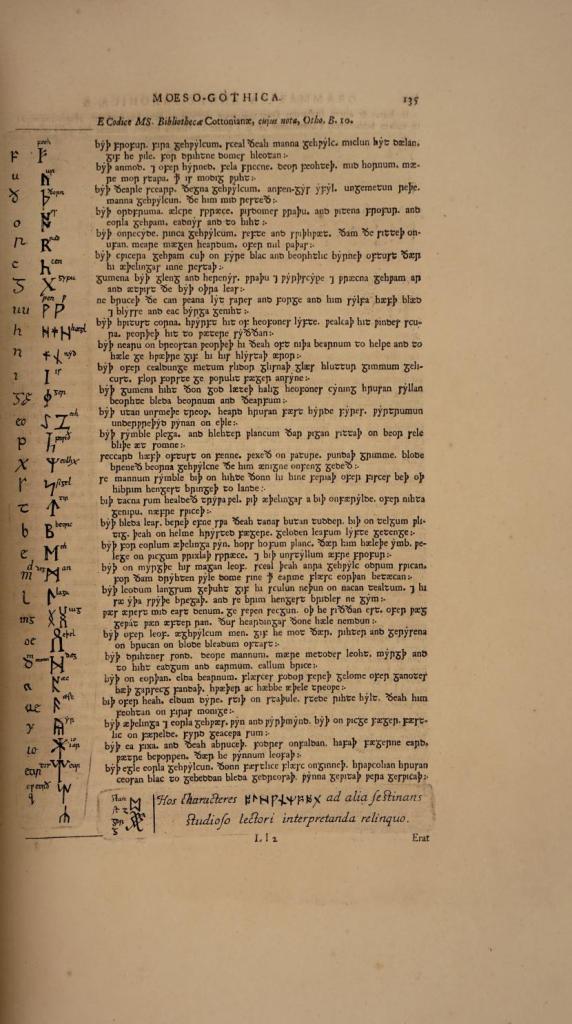
The three Rune Poems that have survived by great fortune to the present day are considered the main source for discerning important evidence about the Germanic runes, such as their phonetic values, names, and symbolic meanings. These writings, which include an Old English, an Icelandic, and a Norwegian redaction, present characteristics specific to this literary tradition, for instance, their peculiar mise en page and riddling verses.
Such similarities have led early scholarship to focus on the idea that the three poems might have originated from an archetypal oral ur-poem developed in early Germanic times that was later disseminated in England, Scandinavia, and Iceland. This assumption would suppose that both the English and the Scandinavians had the same intuition of turning their ancestral oral tradition of runic verses into riddling and mnemonic poems, with the same textual layout and similar imagery.
This contribution thus aims to explore an alternative hypothesis regarding the origins of runic poems, specifically of a potential intertextual origin of the Rune Poem tradition from an Old English original. The analysis of such a hypothesis takes into consideration the codicological features of the witnesses of the three poems, as well as their possible context of production and line of transmission. Such observations are built on the remarks of the most recent body of scholarship on the Rune Poems to offer new insights into this poetic tradition as well as into the Medieval reception of runic material in a manuscript context.
About the speaker:
Martina obtained her undergraduate and master’s degrees in European and American Languages and Literature at the University of Padua, Italy, specialising in the field of philological studies and with a focus on the Old English and the Old Norse textual traditions. Her current main interest is the tradition of the Rune Poems, with a broader focus on runica manuscripta and the late reception of runes in Medieval England and Scandinavia.
Connect with Martina:
Paper 2: Holly Dempster-Edwards, ‘Emotions, Gender and Crusading in Fifteenth-Century Burgundian Prose Epics and Chronicles’
Abstract:
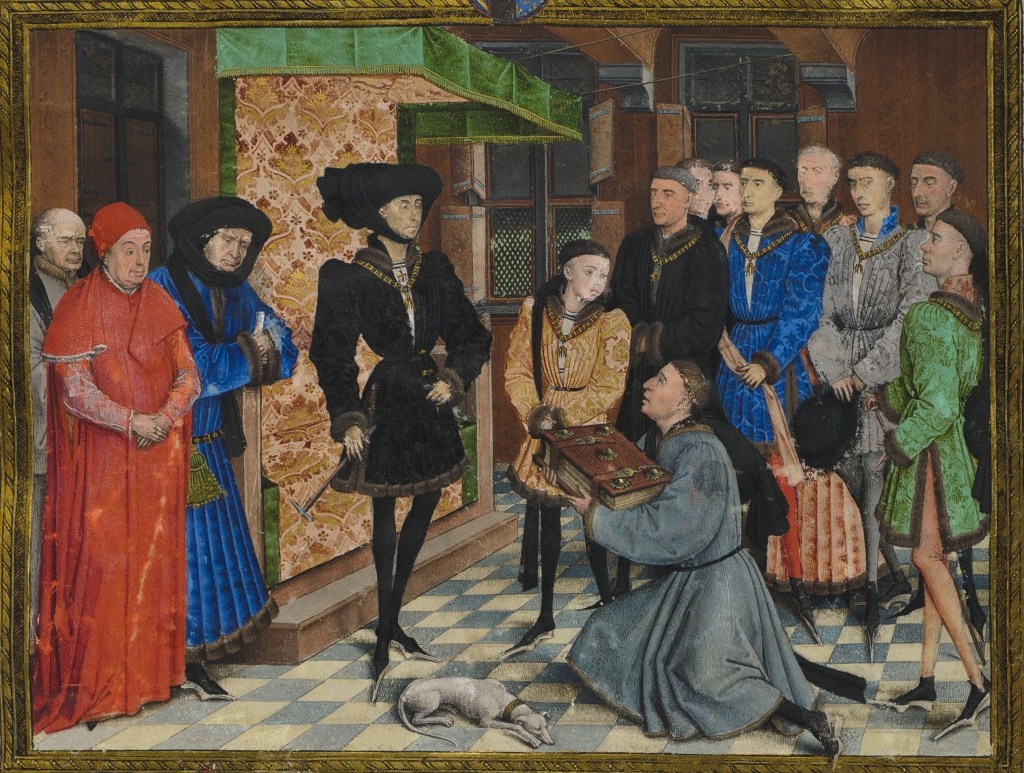
This paper provides an overview of my research on the social function of emotions at the fifteenth-century court of Duke Philip the Good of Burgundy (r. 1419-1467). My methodology builds on that of the historian Barbara Rosenwein, whose concept of ‘emotional communities’ has been highly influential within Medieval Studies. My study is based on emotion words in three Burgundian mises en prose Les Croniques et Conquestes de Charlemaine by David Aubert, La Belle Hélène de Constantinople by Jehan Wauquelin, and Mabrien (attrib. Aubert). I have expanded on Rosenwein’s framework by employing quantitative analysis of the gendered and ‘racial-religious’ distribution of emotions within each text, alongside qualitative textual analysis and examination of text-image relations.
This paper demonstrates how emotions have a social function within this specific emotional community of Burgundian knights and would-be crusaders in response to the Fall of Constantinople in 1453, and how these texts function as literary propaganda which presents itself as didactic; in so doing they attempt to achieve their more subtle aim of maintaining emotion norms within the context of Burgundian chivalric masculinity, hoping to persuade Philip’s courtiers to go on crusade with him in response to the defeat of Constantinople by the Ottoman Turks.
About the speaker:
In 2019, Holly graduated with a First-class BA (Hons) with Distinctions in Modern Languages (French and Spanish) from St Hilda’s College, Oxford. She taught these languages at an international boarding school for a year before undertaking an MA in Medieval Studies at the University of Leeds under the supervision of Professor Rosalind Brown-Grant, from which she graduated in 2021 with a Distinction. In October 2025, Holly completed her PhD in French at the University of Liverpool, under the supervision of Drs Rebecca Dixon and Pollie Bromilow. She has been teaching French to undergraduates at the University of Liverpool since 2021, and in September 2025 also started teaching at the Manchester Metropolitan University. Holly was a 2024 finalist at the University of Liverpool’s Three Minute Thesis competition and also received a runner-up prize in the 2024 Liverpool Literary Festival short story competition.
Connect with Holly:
 The Long Middle Ages
Leave a comment