
Seminar 2 (12/02/2026): Between Alchemy and Richard Rolle
For the second seminar of The Long Middle Ages, we welcome Eszter Sipos and James Rhodes.
Paper 1: Eszter Sipos, ‘The Quinta Essentia of Wine and the Long Middle Ages: Spirits between Court, Laboratory, and Curiosity’
Abstract:
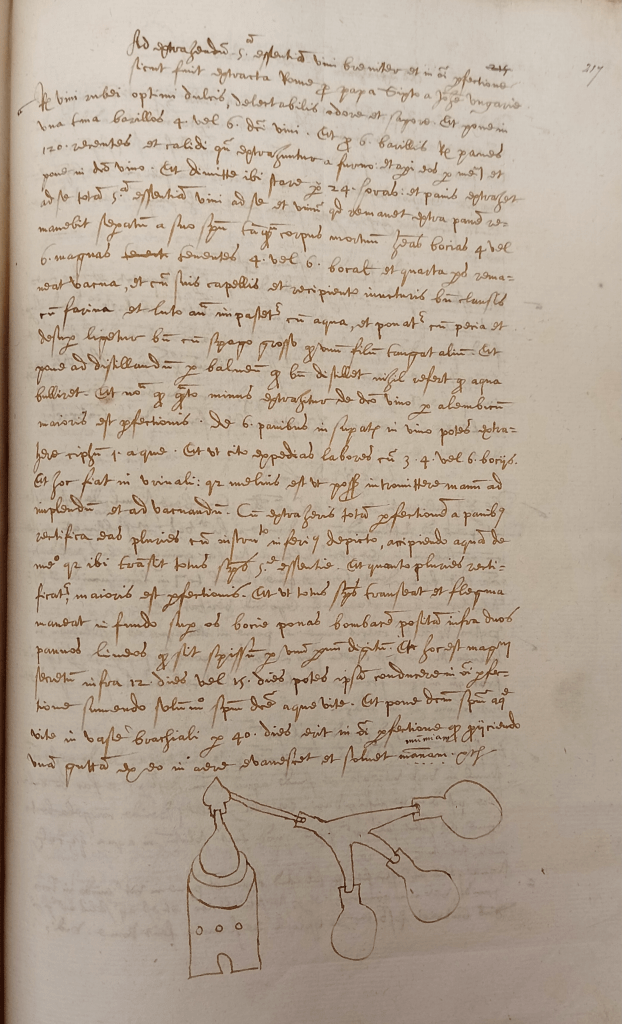
The aim of this seminar is to define the significance of the wine’s quinta essentia within the late medieval world of pharmaco-alchemical practice, while also tracing its later afterlives in early modern cultures of curiosity. A little-known alchemical recipe dated 1322, preserved in the Sloane Collection (Sloane MS 3661), offers a particularly evocative case study that illuminates the spatial and temporal dimensions of knowledge transfer in late medieval and early modern Europe, across Northern Italy, Hungary, and England.
The technological description attributed to a certain Johannes Ungariae, probably trained in Bologna, is in fact a detailed manual of fractional distillation. The text survived in a 1572 copy in the possession of John Elyott. It probably circulated in fifteenth- or sixteenth-century upper ecclesiastical milieus before entering the Sloane Collection, thus bridging late medieval and early modern contexts. This rare example of alchymia operativa, a large-scale recipe for extracting the quintessence of wine, implies a courtly or ecclesiastical laboratory environment closely tied to medicine. Implicitly, it addresses elite demand for highly rectified aqua vitae, while its subsequent transmission through papal and humanist circles situates it within the knowledge economies that would later feed early modern collecting practices, including that of Sir Hans Sloane. Taken together, these materials invite reflection on how late medieval operative alchemy helped to shape techniques of distillation and the dual career of spirits as both a medicinal remedy and a recreational drug.
About the speaker:
Eszter Sipos is a researcher in the early modern history of science, with degrees in History, English, Cultural Heritage Studies, Food Science and Soil Science. Her work focuses on knowledge transfer in the histories of medicine and earth sciences, with particular attention to the circulation of pharmacological practices within early modern Europe.
Paper 2: James Rhodes, ‘From Parchment to Paper: Post-Medieval receptions of Richard Rolle’s Emendatio Vitae‘
Abstract:
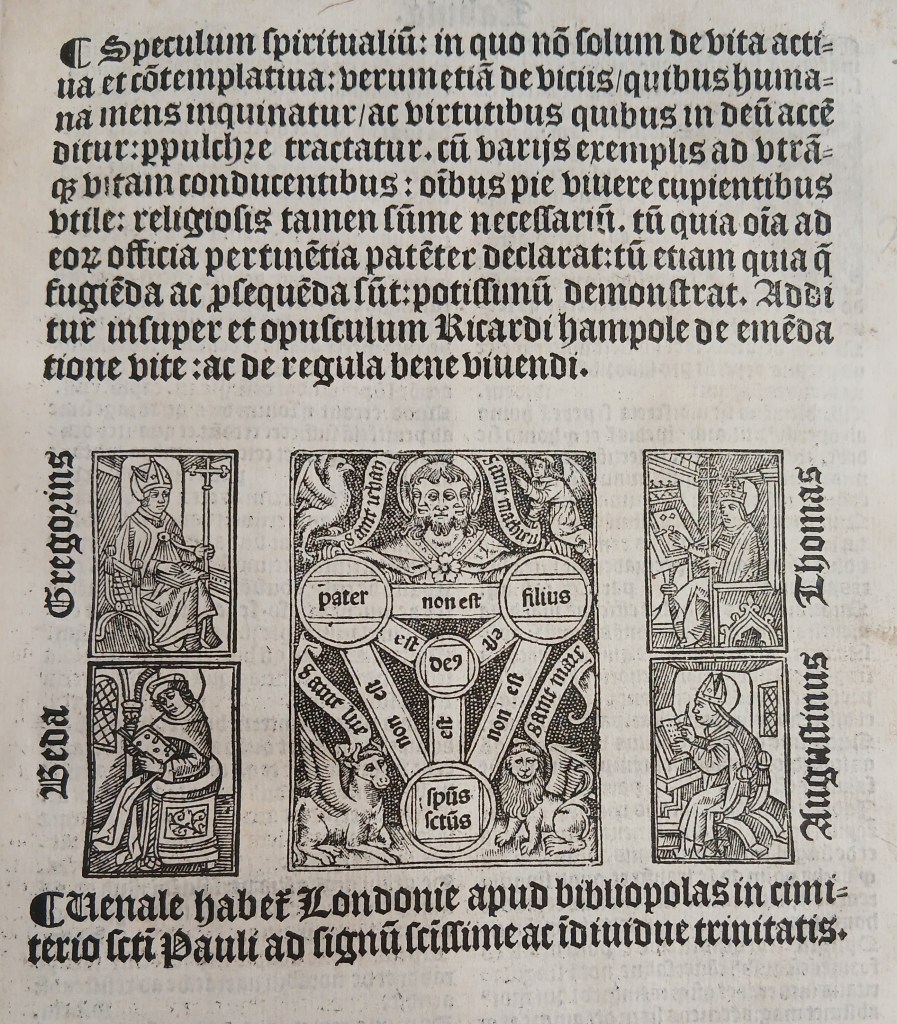
The paper I wish to present concerns the reception of the work of Richard Rolle (d.1349), an English hermit and writer who enjoyed a wide popularity both during his life and after his death – in manuscript and in print. It consists of preliminary research findings into the reception and historiography of Rolle. Rolle’s most widely circulated work, a short twelve-step Latin guide for living spiritually called Emendatio Vitae, was copied in England but also printed on the continent.
I will discuss some key points about the print editions made in 1510 (Paris), 1535 (Cologne), and 1677 (France). These are compendia of Counter-Reformation material containing Emendatio Vitae, and their form and content tell us about post-medieval receptions of Rolle. Rolle’s Emendatio Vitae shows the continuation of ‘medieval’ religious concerns beyond traditional dates and media. It also problematises a sense of ‘canonicity.’ Rolle is usually associated with the ‘Middle English Mystics’ (Julian of Norwich, Walter Hilton, and Margery Kempe), and scholarship since the nineteenth century has situated Rolle into this anglophone and anachronistic category, ignoring a more nuanced image of the hermit existing beyond the Middle Ages. Attention to his Latin work and reception beyond national borders shows a need to re-evaluate his reception by medieval and early- modern readers.
This paper aims to show the importance of reception and early historiography in the analysis of medieval figures who remained popular, albeit in different ways, beyond what we traditionally call the Middle Ages.
About the speaker:
James is a first-year PhD History researcher interested in the reception and afterlife of manuscripts concerning the fourteenth century hermit, Richard Rolle (d.1349). His project’s title is currently: Rolle in Practice: The Textual Afterlife of a Medieval English Mystic (c.1350-1500), supervised by Melanie Brunner and Marta Cobb. His PhD on Richard Rolle focusses on the reception of his most widely circulated work, the Latin Emendatio Vitae, a short text outlining the stages of spiritual perfection. It survives in over 100 manuscripts and James is interested in the scribal and compilatory practices that indicate the ways Rolle was engaged with and integrated into the devotional landscape of fifteenth century England.
Before undertaking this PhD, James studied History at the University of York, obtaining a BA. He then completed a MSt in Medieval History at the University of Oxford. His interest centres on the practice of religion and its relationship to texts. Reception of medieval works on religion is his key concern.
 The Long Middle Ages
Leave a comment