
Seminar 4 (12/03/2026): Manuscripts! Scribal Practice and French Books of Hours
For the fourth seminar of The Long Middle Ages, we welcome Dr Agnese Bargagna and Devon Sherwood.
Paper 1: Dr Agnese Bargagna, ‘Copying What They Could Not Read: Greek Passages and Scribal Practice in Codex Vaticanus Latinus 1873 (V)’
Abstract:
Codex Vaticanus Latinus 1873 (V) is the principal surviving witness to Ammianus Marcellinus’ Res gestae and, apart from a few leaves from the lost Hersfeldensis (M), the source of the entire manuscript tradition. Its centrality makes the circumstances of its production crucial for understanding the transmission of Ammianus’ work. Yet ninth-century scribes at Fulda, particularly regarding Greek passages embedded within the Latin, have received limited systematic study.
It is possible that the same hand responsible for the Latin also attempted the Greek, sometimes struggling with unfamiliar script; in other cases, a different scribe may have responsible solely for the Greek, suggesting varying levels of linguistic competence within the scriptorium. Classifying the types of errors —misformed or substituted letters, disrupted diphthongs, inconsistent spacing, and mid-word corrections — provides a structured way to understand scribes’ reliance on visual imitation alongside comprehension. This approach sheds light on their confidence, training, and collaboration.
The paper also examines how early humanist editors engaged with these passages after the manuscript’s rediscovery. They may have sought to “correct” or regularize the Greek, smoothing unusual letter forms or inconsistent script, or they may have preserved the scribes’ visible uncertainties. These editorial decisions influenced the form in which Ammianus’ Greek circulated in print.
Overall, these perspectives demonstrate that the survival of Ammianus’ work depended on generations of scribes and editors working with material that challenged their expertise. The Greek passages in V offer a compelling case study of fragility, adaptability, and continuity of scholarly knowledge across the Long Middle Ages.
About the speaker:
My research focuses on the transmission, reception, and intertextuality of late Roman historiography, with particular attention to Ammianus Marcellinus. After studying Classics at the University of Pisa, I completed a joint PhD at the University of Macerata and the Université Paris-Sorbonne (2014–2019). My thesis, Ammiano Marcellino e l’Umanesimo, explored the Renaissance rediscovery of Ammianus’ Res Gestae, combining manuscript studies, philology, and intellectual history.
I have also investigated Ammianus’ literary relationship with Tacitus, and examined marginalia and humanist annotations, including the identification of Pomponius Laetus’ hand in ms. Vat. Lat. 7190 and the investigation of Bishop Giovanni Stefano Bottigella’s ownership of ms. Par. Lat. 5820. I have presented papers in Italy, the United Kingdom, and Ireland, and published in Italian, English, and French.
Currently, I am a postdoctoral researcher on The Last Historians of Rome project at the University of Edinburgh (https://lasthistorians.shca.ed.ac.uk/about/ funded by a Standard Grant of AHRC), where I am preparing my doctoral work for publication and leading the creation of a catalogue of approximately 550 manuscripts central to the study of late Roman historiography.
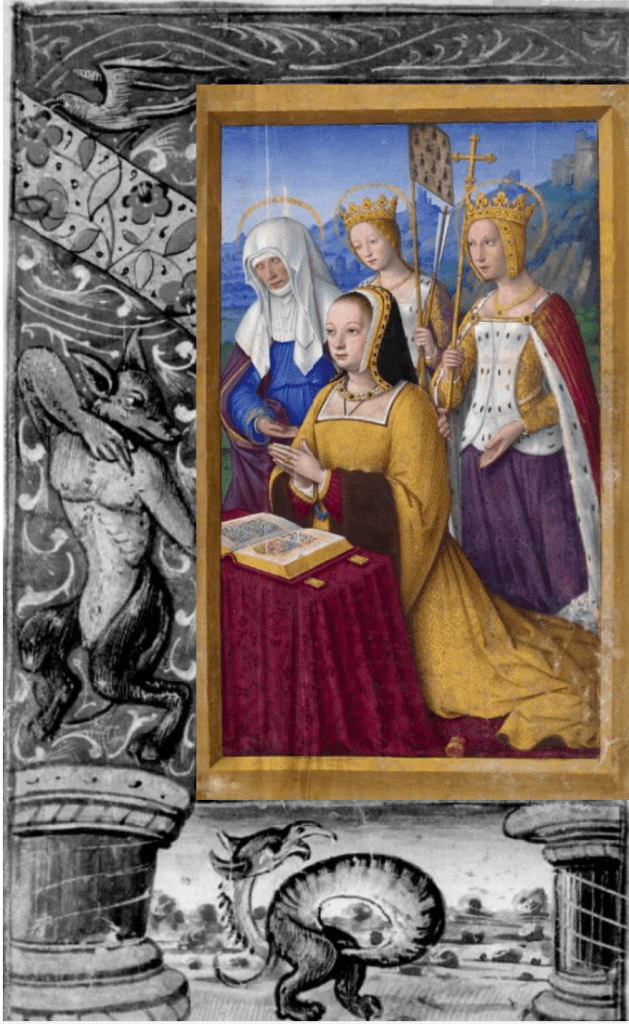
Paper 2: Devon Sherwood, ‘The Books of Hours of Anne de Bretagne, Queen of France: Evolving Self-Representations of Queenship’
Abstract:
Books of Hours, personal Christian devotional codices, developed from the Psalter during the thirteenth and fourteenth centuries. In the fifteenth century, due partly in response to an increasing emphasis on death with resurgences of the Black Plague and to a growing interest in conspicuous consumption, Books evolved to include ornate illuminations and personalized prayers. Many of the most beautiful and well-known examples were produced in France.
Scholarship on French Books of Hours is substantive but has been primarily isolated as art historical. The actual texts in Books have received little attention, and no significant effort to read the varying elements of Books in parallel has been made. The textual, artistic, and material choices revealed in Books reflect the agency of their original patrons, and, observed together, they provide essential clues to how medieval Christians navigated their understandings and practices of devotion, as well as their representations of the self.
The proposed paper will focus on two different manuscripts belonging to Anne de Bretagne, Queen of France: the Bibliothèque nationale de France’s Ms. Latin 1393 and Latin 9474. The two manuscripts, most likely produced within twenty years of each other, provide an opportunity for the comparison of two very different examples of Books belonging to the same person. An interdisciplinary comparison of their textual and artistic elements, in combination with contextual research on the development of Anne de Bretagne’s patronage and political policies, will provide important context about her evolving forms of self-representation.
About the speaker:
Devon Sherwood is a third-year PhD candidate in Medieval History at the University of Toronto. Her thesis work, a comparative study of late medieval French and English Books of Hours, is funded by the Social Sciences and Humanities Research Council of Canada and the University of Toronto.
 The Long Middle Ages
Leave a comment