
Seminar 6 (09/04/2026): The Medieval Islamicate World
For the sixth seminar of The Long Middle Ages, we welcome Dr Mehdy Shaddel and Majideh Qazizadeh.
Paper 1: Dr Mehdy Shaddel, ‘Changing Patterns of Landholding and Extraction in the Early Caliphate, 7th-10th Centuries’
Abstract:
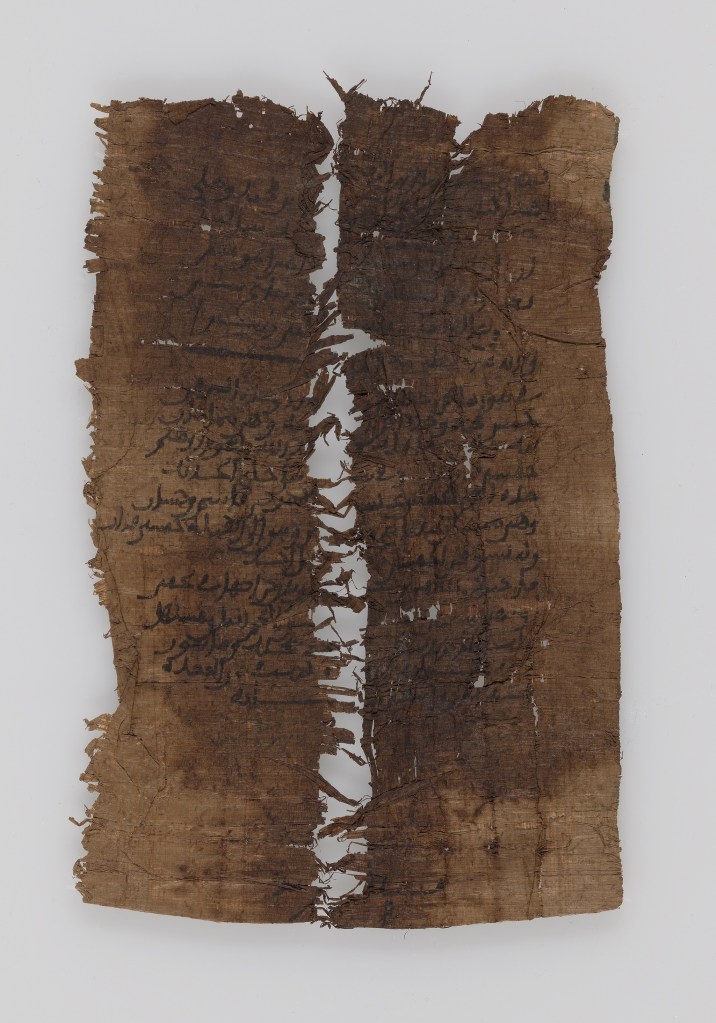
The transition from a predominantly tax based extraction regime in the Near East—closely tied to a professional, salaried model of administering the army—to a feudal system whereby iqṭāʿ (‘fief’) holders would provide military service to a liege lord is usually considered to mark the shift to the ‘mediaeval pattern’ in the Islamic east. This simple picture, however, masks a sea of change that preceded and spawned this transition.
Drawing primarily on unpublished papyrological evidence from the 9th century CE, this talk argues that the ‘tributary’ regime of extraction that dominated the late antique world reached its high-water mark in the early Abbasid period, but following the tax revolts of the 8th century quickly ran aground and was, over the course of a few decades, by and large replaced by tax farmers who acted as middlemen between the state and the peasantry. The state apparatus thus became more decentralised, although, for the time being, the caliph still enjoyed the service of a highly effective and centrally controlled military force that was paid out of tax revenues. The talk concludes by observing that the transition to feudalism in the Near East was a gradual process that took a few centuries to take place.
About the speaker:
Mehdy Shaddel is a Leverhulme Early Career Fellow at the University of Cambridge. He is a scholar of Near Eastern history specialising in Islamic origins and the socio-economic, political, and religious history of the early Muslim empire.
His publications have appeared in such venues as Bulletin of the School of Oriental and African Studies, Journal of the Royal Asiatic Society, Arabica, Der Islam, Journal of Semitic Studies, and Jerusalem Studies in Arabic and Islam. He is currently working on a monograph, tentatively entitled Fiscal Regime and Social Transformation in the Late Antique Near East: The Emergence of the Classical Islamic World.
Connect with Mehdy:
Paper 2: Majideh Qazizadeh, ‘Women, Myth, and the Gendering of Chess in Medieval Islam’
Abstract:
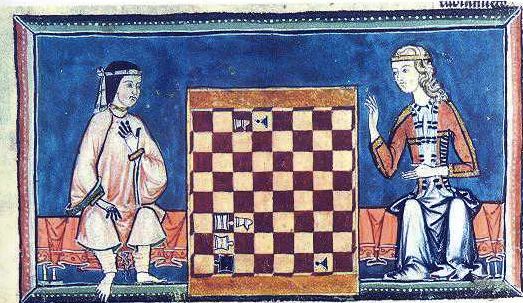
This paper examines the gendered dimensions of chess in the medieval Islamicate world by focusing on two interconnected themes. First, it explores the roles attributed to women in early Arabic and Persian mythic narratives, especially those concerning the invention of chess. I cite examples from Islamicate chess literature, such as the oldest extant Arabic chess manuscript, Kitāb al-Shaṭranj, preserved in an early 12th-century copy but drawing on material attributed to the eighth and ninth centuries scholars, including al-ʿAdlī and al-Sūlī. Although these texts situate the game’s origins in India, the specific stories found in Islamicate sources do not appear in surviving Indian literature. Their distinctively Islamicate forms suggest that these myths were shaped within medieval Islamic societies themselves and therefore reflect the attitudes of those societies toward wisdom, authority, and gender. Women in these narratives are frequently associated with counsel, foresight, or intellectual discernment. These representations can be contrasted with Sasanian Persian accounts of the invention of chess, in which women are entirely absent, emphasising that gendered framings of the game shifted across cultural and literary contexts.
Alongside this mythic material, the paper also engages with broader questions of gender and chess in medieval Islamicate scholarship. Scholars variously characterised the game as a masculine discipline associated with elite refinement and warriorship skills, or, conversely, as a feminine, sedentary pastime that contrasted with ideals of “manliness.” Taken together, these perspectives show that medieval understandings of chess were closely tied to cultural constructions of gender and to its manifestations in everyday social life.
About the speaker:
Majideh Qazizadeh is a Wolfson Scholar in the Humanities and PhD candidate in Arab and Islamic Studies at the University of Exeter. Her research explores the religious, social, and scientific dimensions of medieval Islamicate chess or shaṭranj, with a focus on Arabic and Persian manuscripts.
She holds master’s degrees in Pure Mathematics (Sharif University of Technology), History of Science (University of Tehran), as well as the Erasmus Mundus double master’s in Women’s and Gender Studies. Drawing on her academic background, she brings a multi-disciplinary and multi-levelled approach to the intellectual and cultural history of Islamicate chess. Formerly, while living in Iran, she was a visiting lecturer of mathematics at Payame Noor University and Islamic Azad University.
Connect with Majideh:
View Majideh’s profile at: https://experts.exeter.ac.uk/44329-majideh-qazizadeh
 The Long Middle Ages
Leave a comment