
Seminar 8 (07/05/2026): Ancient Greek Heroes and Italian Tapestries
For the penultimate seminar of The Long Middle Ages, we welcome Maria Sandali and Carlo Scapecchi.
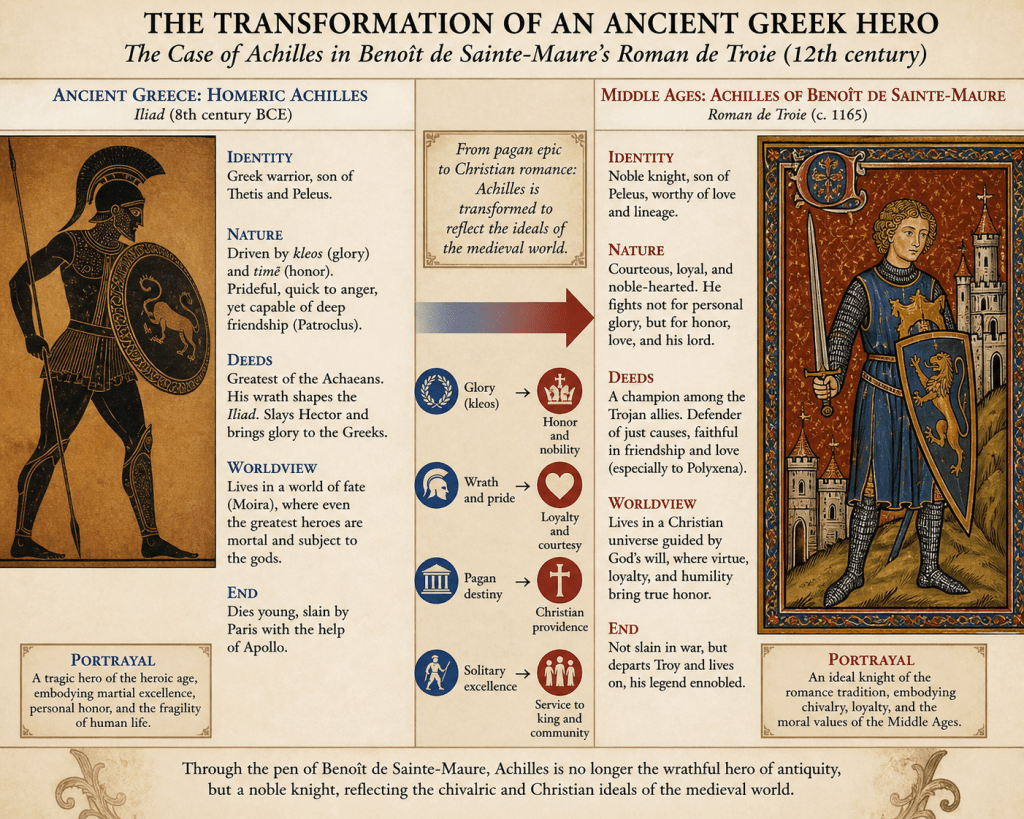
Paper 1: Maria Sandali, ‘The Transformation of an Ancient Greek Hero During the Middle Ages: Achilles of Benoît de Sainte-Maure’
Abstract:
The aim of this paper is to present Achilles’ figure in the Middle Ages, specifically through the work Roman de Troie. Benoît depicts Achilles as a powerful warrior deeply affected by his love for Polyxena, a Trojan princess, and his close relationship with his comrade Patroclus. While Homer’s Iliad focuses on Achilles’ wrath and grief over Briseis, Benoît shifts the emphasis to Achilles’; romantic and emotional attachments, particularly his love for Polyxena and his bond with Patroclus.
The author devotes a significant portion of his poem to the love story of Achilles and Polyxena, portraying Achilles as deeply infatuated with her. This love becomes a central motivation for Achilles, even leading him to consider abandoning the war. Benoît acknowledges the close bond between Achilles and Patroclus, a theme also present in Homer’s Iliad. He portrays their relationship as one of deep affection and loyalty, highlighting the emotional impact of Patroclus’ death on Achilles. Benoît delves into Achilles’ emotional world, exploring his capacity for love, grief, and loyalty.
Despite the focus on love and emotion, Achilles remains a formidable warrior, embodying strength and courage. He is portrayed as a skilled and fearsome fighter, particularly in his encounters with Hector. In essence, Benoît reimagines Achilles, offering a more nuanced portrayal that emphasizes the hero’s emotional depth and his capacity for love, alongside his renowned martial skills.
About the speaker:
Maria Sandali is a Ph.D. Student of the University of Athens. Her Bachelor Degree is in Classics and her Master Degree in Ancient Greek History. Her interests are focused on the period of the Late Antiquity and Middle Ages. In addition, she examines the antiquity’s reception in Roman Times. Her Ph.D. research is about “The cult and the image of Achilles in Roman time” which is an effort to prove the literary image of Achilles under the Roman Empire. She has gained a two-semester grant from A.G. Leventis Foundation.
Paper 2: Carlo Scapecchi, ‘Weaving Tapestries with Wasted and Recycled Silk in Sixteenth-Century Italy‘
Abstract:
Tapestries were considered among the most expensive and elaborate forms of art in the Italian Renaissance. Tapestries were a symbol of prestige and power for rulers and aristocrats all across the peninsula, at least from the 15th century. However, within these rich and sophisticated artefacts, waste and reused materials were widely used. In the silk wefts, we can see the employment of wasted (filaticcio) or second-hand silk, made of pierced cocoons or rag threads purchased from silk-merchants (setaioli), mercers (merciai) and ragmen (stracciaioli).
Using the example of Arazzeria Medicea (Medici Tapestry Workshops) in Florence, the paper will investigate the economy and manufacturing processes for waste and recycled silk, and the production-related reasons for their use in tapestry-making. The paper aims to explore how waste and recycled materials were not discarded but used in the composition and manufacture of goods and objects, even the most prestigious ones.
About the speaker:
Carlo Scapecchi is currently a Lecturer in the Institute of Foundation Studies for Arden University in Leeds. He received a PhD in History of Art from the University of Edinburgh (2023). His doctoral thesis regarded the production of tapestries in sixteenth-century Florence. Last publications included a chapter on Flemish dyeing techniques and recycling processes in an edited volume (eds. Dr Francesca Borgo and Dr Ruth Ezra), titled Wastework (Max Planck Institute, 2025).
A new article on linen manufacture in Renaissance Florence has been recently published (October 2025) in Textile Journal (Taylor and Francis). Forthcoming publications include a chapter in an edited volume on weaving goat hair in the Early Modern Period (2026; St Francis Xavier University/Courtauld Institute) and an article on the architect Gherardo Silvani, based on unpublished documents from the John Rylands Library, The University of Manchester (Bulletin of John Rylands Library).


Leave a comment