
Seminar 9 (21/05/2026): Archaeology Week! Early Medieval Córdoba and the Baltic Amber Routes
For the final seminar of The Long Middle Ages, we welcome Inmaculada Villafranca and Erik Nilsson.
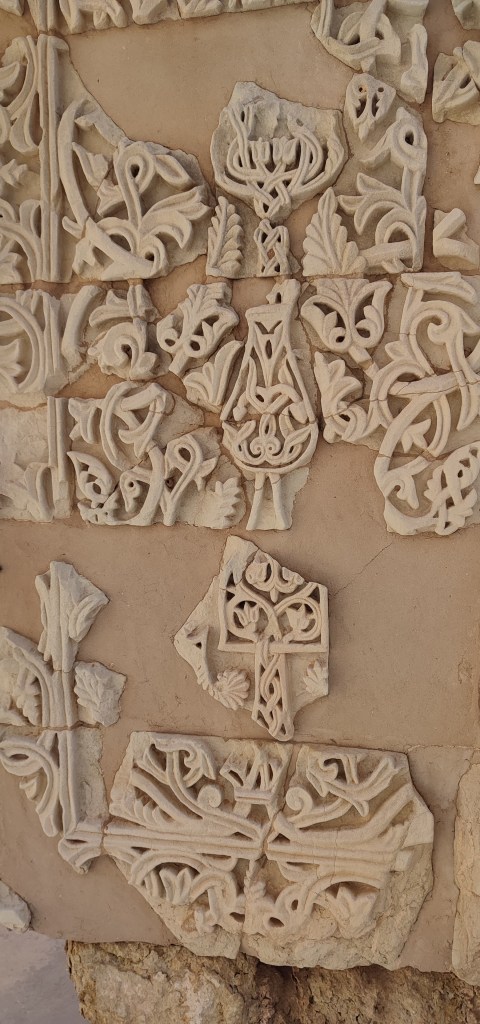
Paper 1: Inmaculada Villafranca, ‘From Late Antiquity to the Middle Ages through a vine branch: Knowledge transmission or common roots? The case of vegetal decoration in Córdoba (Spain) from the 5th to the 10th centuries’
Abstract:
The evolution of Córdoba (Spain) from Antiquity to the Middle Ages is one of the most interesting case studies because of the changes the city went through during its transition from a Roman and Christian city to an Islamic megalopolis. The arrival of the Visigoths in 572 and the Muslims in 711 marked two points of inflexion that apply to historiography but not always to archaeology.
The process of Islamisation resulted in a city that had its very own character and was different, in many ways, from the previous phase. However, the diachronic use of the land, the superimposition of structures, the maintenance of agricultural estates, water supply systems and, of course, the Christian community and its buildings, show a continuity with Late Antiquity.
In this seminar, we will address the topic of architectural decoration as a vehicle to understand not only if taste, and therefore, a cultural bias, was maintained but also workshops, materials and techniques. Vegetal decoration is present in the city during Antiquity, Late Antiquity and the Middle Ages; sometimes the same motifs (like the vine branch) can be found in the different phases. Nevertheless, other meanings, locations and purposes must be taken into account.
This research aims to shed light on the possible transmission of knowledge from the Late Antique to Andalusian Córdoba or the possibility that the similarities among the different examples stem from the common roots of the Visigothic kingdom and the Umayyad East.
About the speaker:
Inmaculada Villafranca is an archaeologist and doctoral student at the University of Córdoba, specializing in caliphal architecture and decoration, with a thesis on Umayyad sculptural decoration (ataurique). She holds a BA in History (University of Córdoba), an LM in Archaeology (University of Bologna), and a Master’s in Heritage (University of Córdoba).
She has participated in archaeological campaigns in Italy and Greece and led multiple interventions in Córdoba. Her research focuses on architectural decoration, heritage documentation, and the cultural continuities between Late Antiquity and al-Andalus.
Inmaculada has been awarded a scholarship and has recently finished an archaeological excavation in front of the Mosque of Córdoba.
Connect with Inmaculada:
On Academia Edu: https://uco-es.academia.edu/InmaculadaVillafrancaJiménez
Paper 2: Erik Nilsson, ‘From Everywhere to Everywhere: Movement Corridors and Shared Spaces Between the Baltic and the Mediterranean (AD 0-500‘

Abstract:
In late antiquity, the Baltic region is often framed as a periphery to the Roman world, which in many ways it was. Yet long-standing traditions of amber exchange show that routes linking the Baltic and the Mediterranean remained active beyond the imperial frontier. While the Amber Routes of the Iron Age are well attested within Roman territory, their northern extensions are far less clearly defined. My project addresses this gap by combining environmental evidence with computational modelling to explore how connectivity may have been structured outside Roman control.
Movement underpins trade, diplomacy, and cultural transmission, yet the routes themselves are rarely examined directly or diachronically. Because such corridors operated within shifting political and environmental conditions, chronology is essential for understanding how, when, and why particular routes were used. By applying least-cost-path analyses to persistent environmental and hydrological realities, I aim to reconstruct potential long-distance corridors linking the southern Baltic coast to the Roman frontier and compare them with dated archaeological proxies to assess their plausibility and development over time.
The corridors under investigation draw on networks active since at least the Bronze Age, yet they also reveal significant change. The Öland solidi, beginning in the early fifth century and ending abruptly around 476, exemplify this dynamism and mirror disruptions such as the Hunnic incursions and the collapse of the Western Roman Empire. Tracing these shifting corridors highlights both long-term continuities and moments of rupture, and offers a foundation for future research into these evolving “Amber routes”.
About the speaker:
Erik is from Sweden and has an academic background in history and archaeology. He holds a bachelor’s degree in Archaeology and a master’s degree in Nordic Viking and Medieval Studies.
Erik’s research interests focus on mobility, connectivity, and spatial questions, particularly regarding movement, interaction, and networks within Viking Age and medieval societies across both the Nordic region and the Mediterranean.
Connect with Erik:


Leave a Reply