
Autumn Seminar 3 (29/10/2026): Medieval Iberian Historiography
For the third seminar of the Autumn series of The Long Middle Ages, we welcome Inês Hortas Marques and Andrei Marcelo da Rosa.
Paper 1: Inês Hortas Marques, ‘The Lady with the Goat’s Foot: Hybridity and Female Agency as the Foundations of a Patriarchal Lineage in Fourteenth-Century Iberian Historiography’
Abstract:
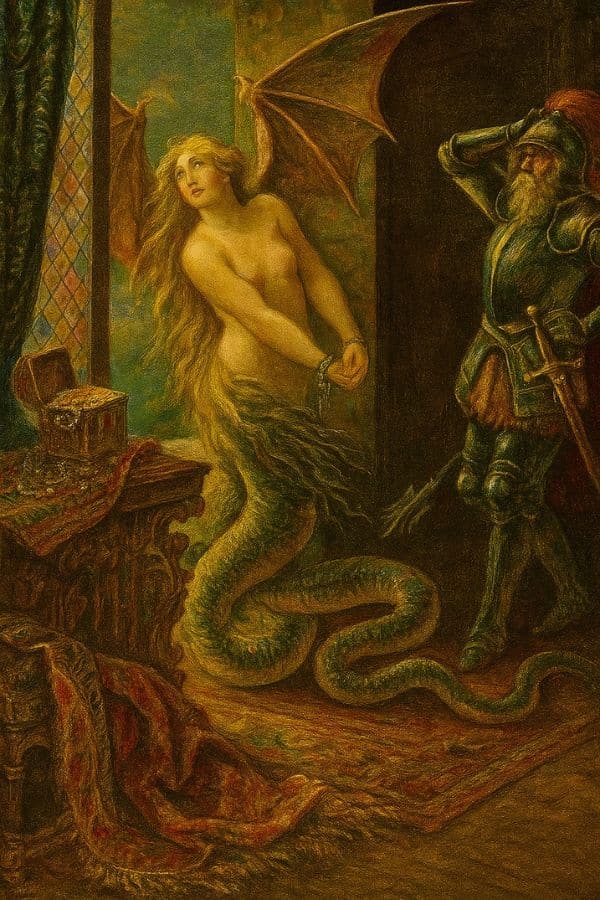
This proposal aims to examine the confluence of the feminine and the animal through the legend of the «The Lady with the Goat’s Foot», preserved in the histographical work Livro de Linhagens do Conde D. Pedro (c. 1340). Intersecting medieval animal studies with a gender-based approach to power relations in the Late Middle Ages in the Iberian Peninsula, this study explores the portrayal of the hybrid body of the protagonist as the embodiment of the subversion of the lineage order, demonstrating that the authority of Biscaia family is rooted in the feminine power of this non-human ancestor whom they were unable to subdue.
Initially encountered during a hunt, the Lady personifies the untamed environment. Her subsequent marriage to the Lord of Biscaia establishes a socioecological alliance between the Christian man and this woman endowed with magical powers associated with nature. When a Christian taboo is violated, the Lady rejects domestic containment and flees back to the wilderness, refusing to be subjugated by that family environment. Crucially, this project argues that while the text attempts to demonize the Lady’s animality, it ultimately reveals that this aristocratic lineage cannot survive without her.
With this in mind, the Lady’s hybridity cannot be seen as merely trope of degradation, but a foundational necessity of the lineage and a source of prestige for the family. In other others, the power and domestic security of the Biscay dynasty require an ongoing pact with the animalised mother. By analyzing this Iberian narrative, this paper aims to broaden the geographical scope of the conference, challenging traditional boundaries between the role of women and animal figures in medieval genealogical literature.
About the speaker:
Inês Hortas Marques is an integrated researcher at the Classical Studies Centre of the University of Lisbon and is doing her PhD in Portuguese Literature (FLUL). She holds a FCT scholarship for her PhD project which focus on the representation of women in Portuguese and Galician medieval literature. Inês has a bachelor’s degree in journalism and communication with a Minor in Portuguese from the University of Coimbra. She completed her master’s degree in Textual Criticism at the University of Lisbon in September 2023.
As a junior researcher, she received a scholarship for the project «Port-Asia – Asia writing in Portuguese: mapping literary and intellectual archives in Lisbon and Macau» (CEComp-UL) and for the project «Portuguese colonial literature: Beyond the memory of Empire» (CEComp-UL). She also collaborated on the project «iForal – Portuguese municipal charters in the Middle Ages: an historical and linguistic approach in the digital era» (CH-UL).
Connect with Inês:
Link to Inês’s Substack: https://substack.com/@medievalistdiaries .
Paper 2: Andrei Marcelo da Rosa, ‘The Knight and the Other in the Grant Cronica de los Conquiridores (14th century)‘
Abstract:
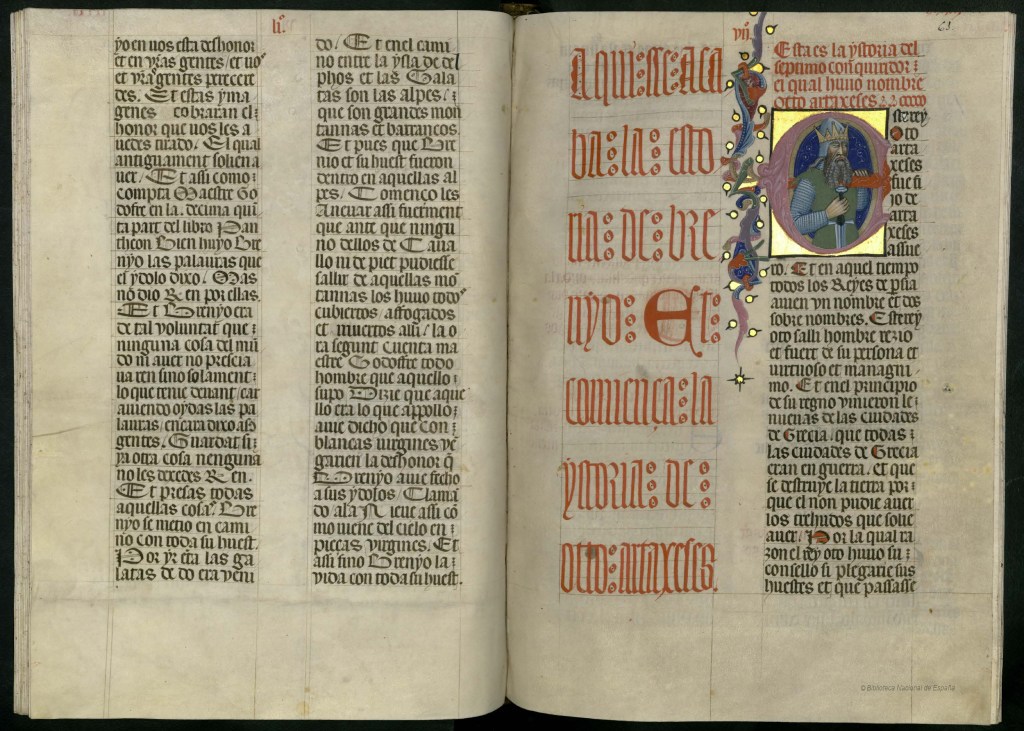
The aim is to present and discuss Juan Fernández de Heredia’s Grant Cronica de los Conquiridores by examining the relationship between the aragonese chronicler’s works and the ideals of chivalry. The question driving this study is: in what way does the chronicle express the construction of a memory of chivalry in opposition to an “other”? Juan, born in the kingdom of Aragon, was appointed by Pope Gregory XI as Master of the Order of Hospitallers in 1377. Juan was also in charge of a scriptorium, initially based on the island of Rhodes, and later in Avignon from 1382 onwards, when he took up residence in the city following a failed attempt to conquer Greek territories.
In this setting, he employed scribes and illuminators to produce translations into Aragonese and to compile works. Among these, the Grant Cronica de los Conquiridores was compiled in the 1430s with the aim of serving as a biographical gallery of notable rulers and knights. Heredia’s work is commonly associated with an attempt to construct a continuous history linking Greek antiquity and Spain. I propose a study focusing on three biographies: those of Tariq and Musa, Heraclius and Genghis Khan. Based on these, I intend to put forward the hypothesis that, in compiling various texts to create a gallery of heroes from the past, Juan drew upon notions of identity and difference to reinforce the image of an ideal knight, against the backdrop of the weakening of the chivalric identity of the Order of Hospitallers.
About the speaker:
Andrei Marcelo da Rosa is a PhD student at the Federal University of Rio Grande do Sul, Brazil. His thesis examines the construction of a chivalric identity and its relationship with the history of Ancient Greece in Juan Fernández de Heredia’s Grant Cronica de los Conquiridores. He holds a master’s degree from the same institution, in which he conducted a comparative study of the two trials of Adenolfo IV of Acerra and the divorce on grounds of adultery between Tamara Komnena and Philip of Taranto, linking them to the Angevin dynasty of Naples’ interest in the conquest of Greece.
Connect with Andrei:
Link to Andrei’s Academia.edu: https://ufrgs.academia.edu/AndreidaRosa
Link to Andrei’s ResearchGate: https://www.researchgate.net/profile/Andrei-Marcelo-Da-Rosa


Leave a Reply